Every week, another frontier AI model arrives wrapped in world-historical language.
The story is always the same: this model is so powerful it may reshape civilization, and so dangerous that only a few centralized institutions can safely control it. The implication is useful to the companies selling access to those models. If intelligence itself is framed as rare, sacred, and centrally managed, then the future naturally belongs to whoever owns the largest cloud endpoint.
But builders know something simpler.
The model is not the whole system.
A model is an engine. Sometimes it is powerful. Sometimes it is brilliant. Sometimes it fails at a task so ordinary that no manifesto can explain the gap between public rhetoric and practical utility.
The long-term value is not in worshipping one model, one vendor, or one terminal session. The value is in the software around the model: the interface, the memory, the data layer, the orchestration, the runtime, and the ability to switch intelligence backends when the current one stops moving.
That is the real sovereign architecture.
The illusion of the single brain
The public conversation around AI is still organized around the idea of the singular brain: one frontier model, one chat box, one cloud provider, one supposedly superior intelligence.
That is not how serious software gets built.
In practice, every model has edges. One model may reason well but fail at layout. Another may write clean code but lose track of state. Another may see the problem but refuse the next step. Another may be excellent today and subtly worse tomorrow after an invisible provider-side update.
The problem is not that models are useless. The problem is treating any single model as the entire architecture.
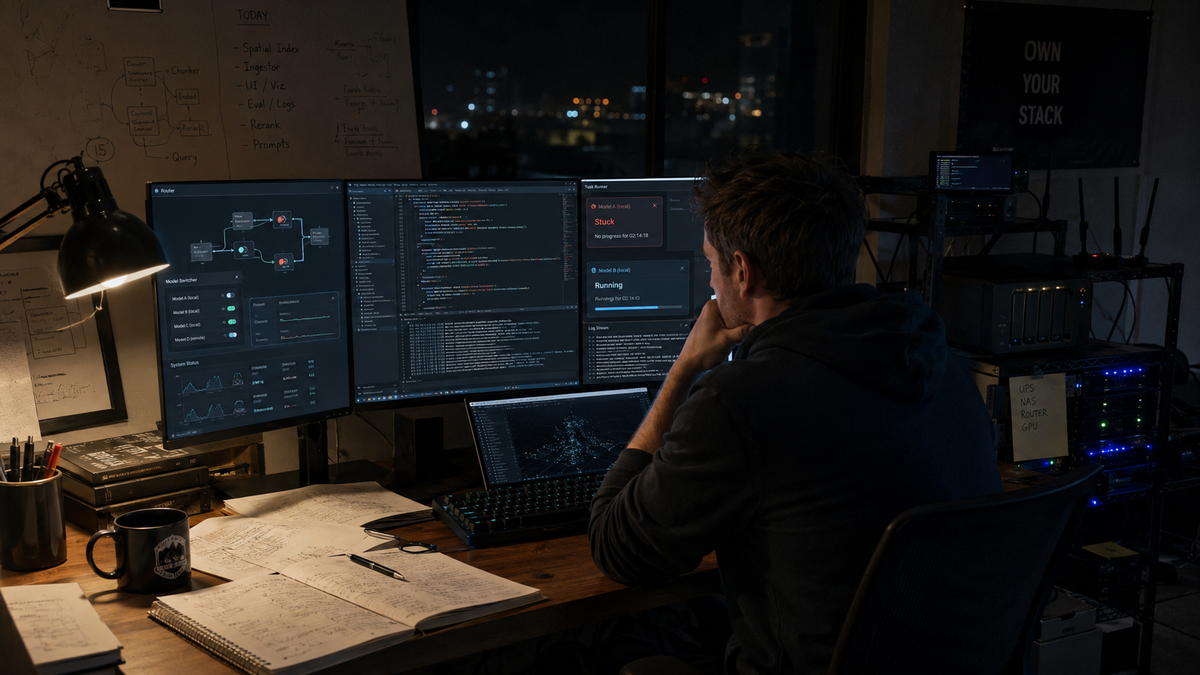
Yesterday, while working on Hyperia, we spent hours wrestling with a cutting-edge frontier model over a basic interface problem: a terminal shell pane needed to seat correctly beneath a newly split web viewport.
This was not a grand philosophical challenge. It was geometry. Layout. State. The kind of problem software either handles or does not.
The model could discuss the problem. It could explain parts of the interface. It could generate plausible fixes. But it kept circling the same square.
That is the lesson.
When the system is stuck on one square, the answer is not to keep begging the same model to become unstuck. The answer is to switch the backend until movement is found.
No move, change beast. 🦀
The real moat is movement
The future of AI development will likely look less like someone sitting inside one vendor's tool forever and more like agent-aware environments such as Cursor, Zed, Hyperia, and whatever comes next.
Claude Code, or any single model-bound interface, can be useful. But usefulness is not sovereignty.
A sovereign system does not trap the developer inside one rented brain. It keeps the important pieces outside the model:
the codebase, the logs, the memory, the workspace state, the permissions, the containers, the agent history, the local data, the operational context.
That is where compounding value lives.
Models will change. Rankings will change. Vendors will tune, patch, throttle, deprecate, reprice, and sometimes break their own products. The data remains. The interface remains. The memory remains. The orchestration remains.
The side that owns those layers owns the leverage.
A model can be swapped. A mature data layer cannot be casually replaced. A trusted local runtime cannot be conjured after the dependency has already failed. A spatial interface built for human-machine collaboration is not a skin over a chat box. It is part of the cognition of the system.
The pillars of sovereign architecture
At DeepBlue Dynamics, we are building around one conviction: the future belongs to systems that can move.
Sovereignty means self-determination over the interface, the data, and the compute.
1. Cognitive sovereignty: spatial interfaces
Hyperia rejects the buried-tab model because hidden tabs are hostile to deep work.
Complex systems require visibility. The human needs to see what is open. The agent needs to see what is open. The workspace itself has to become shared state.
A serious AI interface is not just a prompt box. It is a spatial environment where terminals, documents, browsers, agents, and application views can stay visible and addressable.
If the agent cannot see the room, it cannot reliably work in the room.
2. Data sovereignty: memory that belongs to the user
The most important asset is not the answer a model gives today. It is the accumulated context that lets future work become faster, safer, and more precise.
That includes project memory, local logs, source code, prior attempts, failures, constraints, decisions, and the working shape of the environment.
This is why memory infrastructure matters. Ferricula is not just a convenience layer. It is part of the sovereign stack. It keeps the durable context outside the rented model.
The model should consume context. It should not own it.
3. Backend sovereignty: intelligence as a replaceable component
A model is an engine component, not the whole car.
If one model cannot solve a problem, the system should be able to route the task to another. Different API, different vendor, different local open-weights model, different runtime. The user should not have to rebuild their workflow because one provider's model got stuck.
This is the practical meaning of model agnosticism.
The goal is not to prove loyalty to a lab. The goal is to keep the system moving.
4. Infrastructure sovereignty: local runtimes
Real autonomy requires control over compute.
Cloud APIs are useful, but they are not a foundation you fully own. Public cloud dependencies bring vendor lock-in, pricing volatility, policy exposure, and geopolitical data risk.
That is why DeepBlue Dynamics runs machine agents inside isolated local environments such as Nemesis8, on physical hardware the operator controls.
Private data, logs, codebases, and runtime state should stay inside the fortress.
The agent can reach outward when useful. But the ground beneath the system should not belong to someone else.
Why DeepBlue Dynamics builds this way
DeepBlue Dynamics is not chasing the holy model.
We are building the ground beneath the models.
Hyperia gives the human and machine a shared spatial workspace. Desktop download, no other dependencies.
Ferricula preserves memory and context outside any one provider.
Nemesis8 gives agents isolated local execution environments. Desktop download; runs on Docker Desktop or Podman.
GrubCrawler gives the agent eyes on the open web — the kind the model vendor's built-in "browse" tool keeps telling you it can't see, because every anti-bot wall on the modern internet was built specifically to defeat that built-in tool. Owning the crawler means owning the field of view.
Together, these systems make model switching possible without losing the thread. That is the point. If the current model cannot move, switch models. If the cloud changes terms, keep running. If a vendor breaks the tool, preserve the work.
The future of AI will not be one giant brain in the sky and everyone else renting permission to think.
It will be sovereign systems: local, durable, model-agnostic, data-centered, and built to keep moving.
The model is not the moat.
The moving system is.
If a model fails, use another one. Just make sure your data, your memory, your interface, and your compute are not trapped underneath it.
// transmission ends