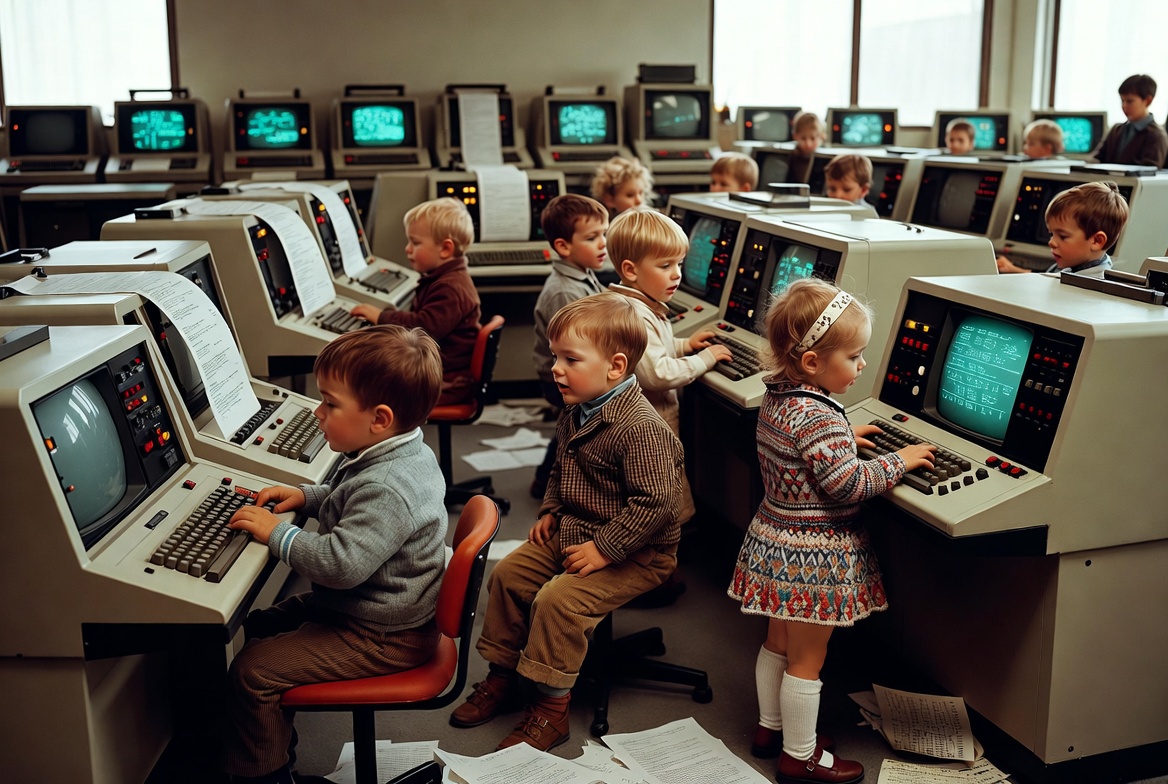
I was a toddler when glass teletypes were taking over computer rooms.
Before those green-phosphor CRTs illuminated dark offices, interactions with computers were loud, mechanical, and paper-bound. You punched cards or typed into clunky, roaring teletypes that clacked out responses line by line onto physical rolls of paper. The shift to a glass screen wasn't just a hardware upgrade; it changed the psychogeography of computing. It made input feel instantaneous, direct, and alive.
Decades later, in 2016, Guillermo Rauch and the team at ZEIT (later Vercel) shipped HyperTerm and proved something equally important: a terminal built entirely on Electron, React, and CSS could be beautiful, extensible, visually coherent, and cross-platform without becoming a toy. You could style your prompt the way you'd style a web page and pop open Chrome DevTools to inspect it. Its maintainers, contributors, plugin authors, and users built one of the most recognizable terminal projects of the last decade.
Then, sustained product development stopped.
The last public canary release shipped in July 2023. The canary branch saw minor dependency housekeeping through early 2024, but the product itself no longer had a functioning development cadence. Hundreds of valid bug reports and feature requests remained open. Dozens of pull requests accumulated without a realistic path to review or integration.
That is not an accusation: it is simply the state of the vessel. Open-source maintainers do not owe the world perpetual labor. People move on. Companies change direction. Priorities shift. But open source gives us a handoff mechanism.
License in hand, DeepBlue Dynamics has officially raised the flag. Today we opened issue #8203 in Vercel's Hyper repository, not as a complaint or a feature request, but as a notice of succession.
Hyperia is the maintained, active continuation of Hyper.
Meet Hyperia:
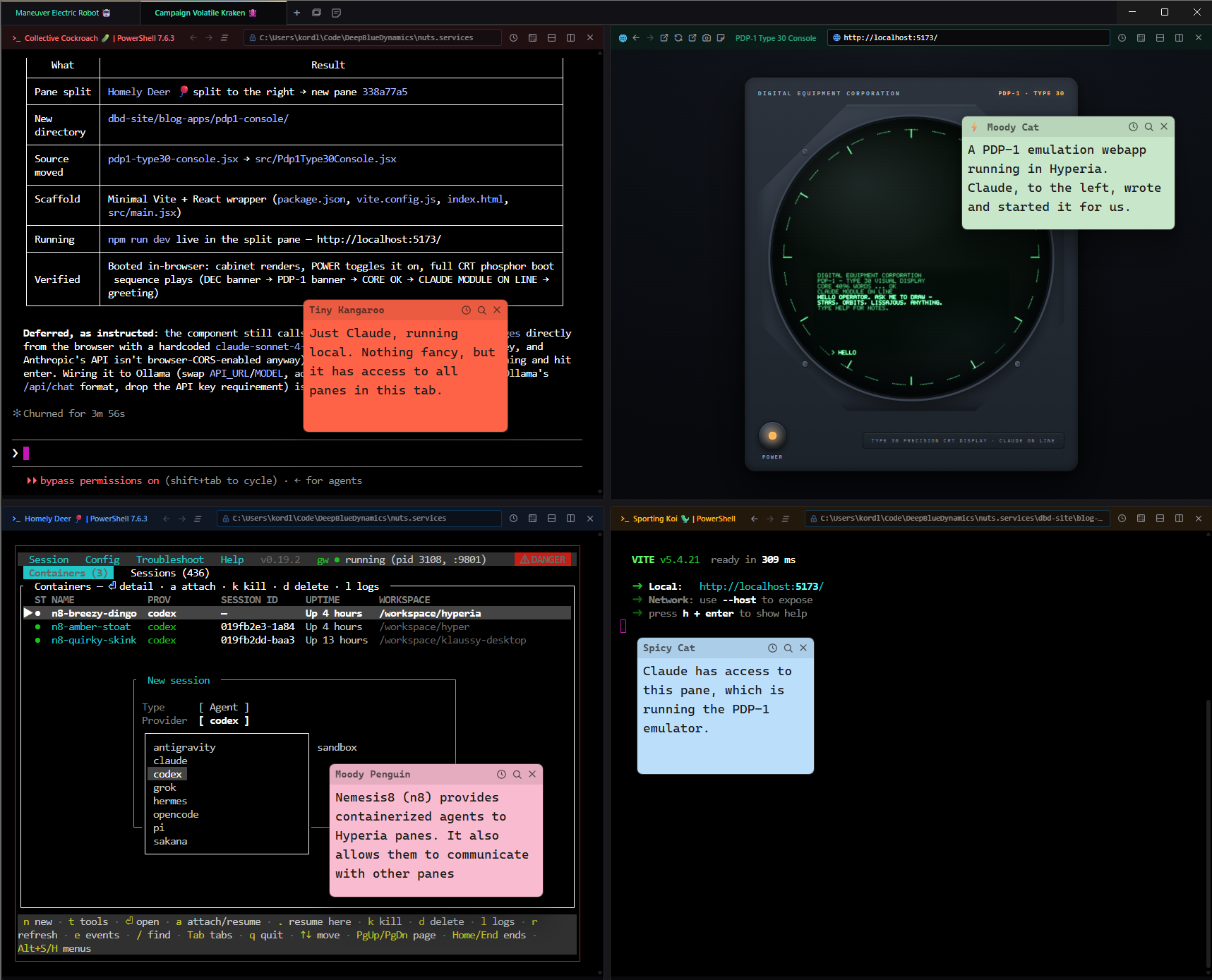
The shift: driving the terminal into the agentic era
We didn't fork Hyper just to change the logo and collect GitHub stars. We changed the operating model of how human and artificial intelligence interact at the command line.
The traditional terminal is a blind, single-user byte pipe designed for one human operator. But software development has shifted. Today, the terminal is where local models become active processes, and where AI agents touch source code, containers, and operating systems.
Hyperia is purpose-built for two operators: a human and an agent sharing the same visible surface.
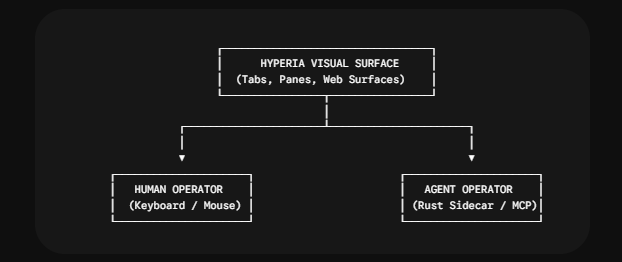
What Hyperia ships with today
- Dual-operator architecture. A native Rust sidecar exposes the terminal over the Model Context Protocol (MCP) and HTTP. Agents can open tabs, split panes, run commands, inspect viewport state, and search shell history without blindly dumping raw bytes into a TTY.
- Human-in-the-loop consent. The human remains captain. Agents cannot silently hijack focus. Driving an unowned pane requires explicit permission, and workspace status indicators clearly signal whether an agent is connected, working, or idle.
- Expanded engine room. Around this core, Hyperia already ships with named addressable panes, shell profiles, embedded web surfaces, persistent Stickys, physical Stream Deck controls, scriptable CLI execution, and local memory search.
This isn't a cosmetic theme layered over legacy software. It is a terminal engine re-engineered for sovereign, agentic work.
Honoring the backlog: carrying the unfinished work
An issue tracker without active releases isn't a roadmap: it's a historical record of intent. Hyper's repository contains years of thoughtful bug reports, user friction, and brilliant ideas from community members. Those records should not be erased or quietly rebranded as our own inventions.
We have selected high-value areas from the upstream Hyper backlog and mapped them directly into Hyperia's active development pipeline, maintaining clear links back to the original authors:
- Interaction debts. Native tab and split-pane reordering, clickable file paths, active-process termination warnings, and strict keyboard/mouse/tmux input handling.
- Workspace reliability. Named session save and restore, layout import/export, and declarative CLI-driven window management.
- Engineering baseline. Find-in-pane optimization, high-scrollback performance tuning, startup benchmarks, and precise cursor, glyph, and ligature rendering.
We aren't importing these as vague promises. They are scoped issues with strict acceptance criteria, moving through an active release pipeline.
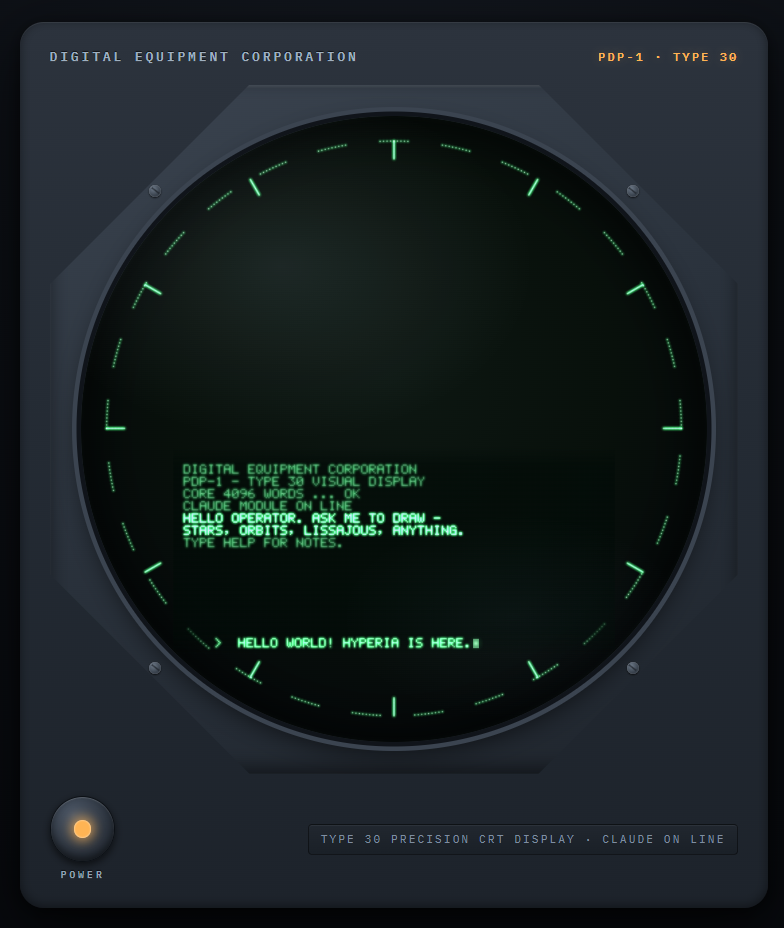
These are our colors
DeepBlue Dynamics builds sovereign infrastructure: local-first systems where you own the state, control the compute, and maintain absolute visibility over what your machines are doing.
If the terminal remains a black box where an AI agent blindly executes shell scripts out of sight, the entire local AI stack is pretending to be more reliable than it actually is. Hyperia provides the bridge required for modern human-machine collaboration: shared state, explicit boundaries, protocol-level access, and full transparency.
A repository can remain where it is while stewardship moves elsewhere. Stars don't maintain software. Releases do.
The colors are up. The issues are filed. The releases are moving.
We'll take it from here.
Hyperia is built by DeepBlue Dynamics. Source code, binary builds, and documentation are available on GitHub.
// transmission ends